
Buyer checklist
How to choose a Data Studio agency: a checklist for buyers
Knowing how to choose a Data Studio agency comes down to four things: who owns what they build, how they prove the numbers are right, how they handle limits and broken connectors, and whether they can support you after launch. This checklist is for marketing agencies, ecommerce brands and finance or operations teams comparing a shortlist. We wrote it from the side of an agency that is often asked to rescue reports another supplier left behind.
Quick answer
How do I choose a Data Studio agency?
How to choose a Data Studio agency comes down to proof and ownership: confirm that reports and data sources will belong to your account, that totals are reconciled against source systems, and that the team can explain how it handles GA4 quotas, blend limits and broken connectors. Then compare written scopes and support plans.
- Ownership of reports and data sources must sit with your company, written into the contract.
- Ask how the agency reconciles dashboard totals against GA4, ad platforms or finance systems.
- Check practical knowledge of limits such as GA4 quotas and the five-source blend cap.
- Marketing agencies buying white-label work need a repeatable client onboarding process.
How to choose a Data Studio agency: what belongs on your checklist?
Start with ownership, quality checks and support, then look at design. A beautiful dashboard that nobody trusts, or that stops refreshing when one login expires, costs more than it saves.
Use the checklist below while you read proposals. Any item that a proposal does not mention is a question for the next call.
- Reports, data sources, Sheets and BigQuery datasets are created in or transferred to your account.
- Data source credentials are chosen deliberately and explained, owner's or viewer's.
- Totals are reconciled against named source systems before launch.
- Calculated fields, CASE logic, blends and parameters are documented.
- The team has shown dashboards in your industry or function.
- Response times for broken reports are written down.
- Running costs such as connectors, BigQuery and Pro licences are listed separately.
- More than one person on the agency side understands your setup.
Which questions should you ask a Data Studio agency?
Ask questions that require practical answers. An experienced team answers them in specifics, with the names of fields, connectors and settings, rather than general promises.
Pay attention to how the agency answers, not only what it says. A team that asks about your audience, your sources and your decisions before it talks about chart types is usually a team that has learned from projects going wrong. A team that jumps straight to templates may be selling the same report to everyone.
- What would you do if our GA4 report hits the Data API quota of 14,000 tokens per project per property per hour?
- How do you join more than 5 sources when blends allow only 5 and only equality joins?
- How will you notice that a connector has stopped working, given Data Studio does not warn anyone?
- Which of our sources need partner connectors, and what will they cost us each month?
- When would you move our data into BigQuery, and how would you partition it?
- Who on your team builds the work, and who covers when that person is away?
- Can you show a dashboard you built for a similar business and explain one design decision in it?
What are the red flags when choosing a Data Studio agency?
The clearest red flag is an agency that keeps your reports in its own Google account and only shares them with you. Your reporting then depends on the relationship, and leaving becomes a rebuild.
Other warning signs show up in the proposal itself. If it lists charts but never mentions data preparation, reconciliation or documentation, the work behind the charts is either missing or will be billed later.
Watch the sales process too. If nobody asks to see a sample of your data, or the person selling cannot name who will build the reports, expect the same gaps during delivery.
- Reports and data sources stay in the agency's account after launch.
- No mention of reconciliation or testing against source totals.
- Claims of special status with Google that cannot be checked.
- Every metric routed through a connector account the agency controls.
- Confusing Data Studio with Looker, the separate enterprise BI platform.
- A quote produced before anyone has seen your data.
Who should own the reports an agency builds?
Your company should own them. Reports, data sources, helper Sheets and BigQuery datasets should live in accounts your company controls, ideally a shared company account rather than one employee's.
Data Studio Pro makes this easier for larger teams. Pro ties content to Google Cloud projects with IAM, so reports belong to the organisation rather than a person, and team workspaces give roles of Manager, Content Manager and Contributor. Pro costs $9 per user per project per month for creators, editors and managers, and viewers need no licence.
Write ownership into the contract: where the work is created, when ownership is transferred, and what the agency keeps after the engagement ends.
How should a Data Studio agency check the numbers?
A serious agency reconciles every key metric against its source before launch. That means comparing dashboard totals with GA4, Google Ads, the CRM or the finance system for the same date range and filters, and explaining any difference.
Differences are normal and usually have reasons: time zones, attribution settings, sampling, filters or rows dropped by a blend whose join keys do not match. What matters is that the agency finds them, documents them and agrees them with you, rather than leaving your team to discover them in a board meeting.
Ask to see the reconciliation sheet. A short table of metric, source value, dashboard value and explanation is enough, and it becomes the reference for anyone who questions a number later.
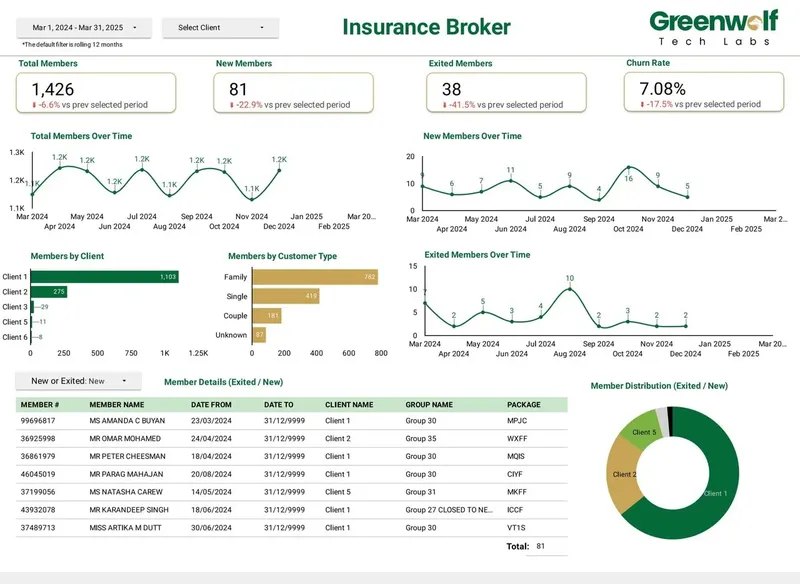
For our Australian insurance brokerage client, reconciliation was the core of the work. Data arrived as messy .xls files from several insurers, so we automated the flow into Google Drive and a central Google Sheet, applied the business rules there, and fed the dashboard from that. Reporting accuracy rose from about 75% to 99%, and report preparation fell from 4 to 5 hours to under 5 minutes.
What should marketing agencies look for in a white-label partner?
Marketing agencies buying white-label Data Studio reporting need a partner that can onboard client after client without quality slipping. Look for a repeatable process, not just a nice template.
Data Studio has no client management built in. Each new client means copying a template, replacing data sources, setting credentials, adding branding and scheduling delivery. A good partner has a checklist for this and can tell you how long onboarding takes and how errors are caught.
- Your branding only, with no partner name in reports or emails.
- Client data sources owned by you or your client, not the partner.
- A monitoring routine for broken connectors across all client reports.
- Clear handling of GA4 quotas when many client reports refresh at once.
- Confidentiality terms covering your client list and data.
Should you choose an agency with industry experience?
Industry experience shortens discovery because the agency already knows which metrics matter and where the data usually breaks. It is worth asking for, especially in operations and finance reporting.
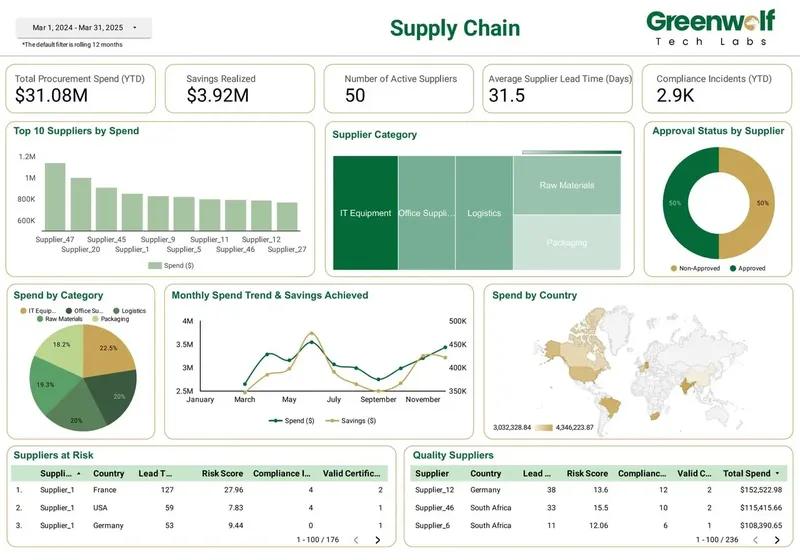
Our team has built Data Studio dashboards for an insurance broker tracking membership and churn per client scheme, a healthcare and pharma brand team tracking sales, Rx volume and actual versus forecast, a manufacturing unit tracking units lost per machine and causes of loss, a logistics operation tracking orders by stage and delayed deliveries, and a procurement team tracking spend, savings, supplier lead times and suppliers at risk.
If an agency has no work in your industry, that is not automatically a reason to rule it out. Ask how it would learn your metrics, and whether its discovery process starts from your existing spreadsheets and reports. A good team can usually rebuild the logic your staff already use, then improve it.
How does Greenwolf Tech Labs approach a new client?
We start with a free review of your sources and goals, then send a fixed-price quote with a written scope. Work is built in your accounts, totals are reconciled before launch, and handover includes documentation and a walkthrough.
Greenwolf Tech Labs has delivered 100+ projects for 200+ clients in 50+ locations over 8+ years, working remotely from offices in India and the USA. Our team covers business intelligence, data analysis, automation and market research, so more than one person understands your setup.
Case study · Insurance brokerage, Australia
From 4-5 hours of spreadsheet work to a report in under 5 minutes
Monthly reports were assembled by hand from inconsistent .xls files sent by several insurers. The files now land in Google Drive, are mapped into one central sheet with the business rules applied, and feed a Data Studio dashboard.
- Report time: 4-5 hours to under 5 minutes
- Reporting accuracy: about 75% to 99%
- Visibility across insurers: limited to real time, with filters
FAQ
Frequently asked questions
What is the most important thing when choosing a Data Studio agency?
Ownership. Make sure reports, data sources and supporting datasets are created in or transferred to your company's accounts. Without that, changing agencies later means rebuilding everything.
How can I tell if a Data Studio agency is experienced?
Ask practical questions about GA4 quota errors, the five-source blend limit, owner's versus viewer's credentials and BigQuery partitioning. Experienced teams answer with specific fixes. Also ask to see a dashboard similar to yours and hear the reasoning behind it.
Should a Data Studio agency reconcile numbers before launch?
Yes. Key totals should be checked against GA4, ad platforms, CRM or finance systems for the same period and filters. Any difference should be explained and written down so your team can answer questions later.
What should a white-label Data Studio agency provide?
Reports branded as yours, client data sources owned by you or your client, a repeatable onboarding process for new clients, monitoring for broken connectors and confidentiality terms. Ask how long onboarding a new client takes.
Do I need Data Studio Pro to work with an agency?
No. Agencies can build in the free edition. Data Studio Pro helps larger teams that want organisation-owned content, team workspaces, hourly scheduling or audit logging, at $9 per user per project per month for creators, editors and managers.
How many Data Studio agencies should I compare?
Two or three is usually enough. Give each the same brief and data sample, then compare written scopes, ownership terms, reconciliation steps and support plans rather than only the price.
Keep reading
Related pages
Get started
Tell us what your reporting has to do
Describe the dashboards you need, who reads them and where the data sits. We reply within one business day with an approach, the connectors involved and a fixed-price plan.
- Free 30-minute reporting review
- Fixed quote before any work starts
- Everything built and owned in your Google account
Prefer email? info@greenwolftechlabs.com
Get a free proposal
Two lines is enough to start.